Dec 19, 2025
🧠 The Spec-Driven Operating Mode
Thought Leadership
Why high-scale teams are moving beyond story-centric Agile and what replaces it as the planning backbone
For years, Agile has been the default operating model for software teams. User stories, backlogs, sprints, and ceremonies promised adaptability and speed. For small, co-located teams building relatively contained products, that promise often held.
⚠️ The Challenge
But as organizations scaled with more teams, more dependencies, more regulation, more distribution, and now AI-assisted development, the model started to crack.
Backlogs ballooned. Alignment decayed. Delivery confidence dropped. Teams shipped “done” stories that did not add up to coherent system behavior.
💎 The solution
A different model has been quietly emerging across large technology companies, financial platforms, and infrastructure teams:
A spec-driven operating model.
Most teams adopting this model layer it on top of existing Agile or flow-based execution rather than replacing those rituals outright.
Contents
This document explains:
What spec-driven development is
Why story-centric Agile breaks down at scale
How planning works in a spec-driven world
The artifact hierarchy (Outcomes → Capabilities → Specs → Tasks)
What makes up a good spec
How change, MVPs, and versions are handled
What this means for Product Managers, Engineers, and TPMs
How to implement this model using Jira and Confluence
1. What Is a Spec-Driven Operating Model?
At its core, a spec-driven model makes one fundamental shift:
👁️ System behavior is defined explicitly in specs, not implicitly via user stories.
Instead of decomposing work into dozens of stories that approximate intent, teams define one or more specs that describe the system change end-to-end:
What the system must do
Under what constraints
With what invariants
And how success is measured
Specs become the source of truth. Backlogs become an execution detail.
⚠️ This is not Big Design Up Front, nor a return to Waterfall.
Specs are:
Thin
Evolving
Versioned
Explicit about uncertainty
The difference is not whether change happens, but whether change is controlled and visible.
2. Why Teams Are Moving Beyond Story-Centric Agile at Scale
👁️ Agile optimizes for conversation. Specs optimize for precision.
Conversation is still essential — but conversation alone does not scale linearly. At large scale, it needs a stable, precise anchor that survives distribution across teams, time zones, and automation.
Common failure modes of story-centric Agile at scale
👎 User stories hide system-level behavior
👎 Non-functional requirements are implicit or lost
👎 Cross-team dependencies explode
👎 Backlog grooming becomes planning theater
👎 “Done” stories fail to integrate cleanly
What a spec-driven model fixes
💪 One shared definition of behavior
💪 Explicit contracts between teams
💪 Early freezing of high-cost decisions
💪 Clear boundaries for acceptable change
💪 Fewer coordination and alignment meetings
This is why companies like Google (design docs), Amazon (PR-FAQs and contracts), Stripe (API-first design), and Netflix (system ownership models) have converged on spec-centric documentation cultures — even while many teams continue to use sprints, kanban, and continuous delivery underneath.
3. Why AI Makes Spec-Driven Development Urgent
AI-assisted development accelerates this shift. AI agents need:
Explicit constraints
Clear invariants
Deterministic acceptance criteria
User stories are narrative and ambiguous. They are poor prompts for agents.
Specs, by contrast, provide:
Structured intent
Machine-readable boundaries
A shared interface between humans, teams, and AI systems
In practice, modern workflows increasingly follow this pattern:
Specification → AI-assisted generation → validation
For example, a “Contract Extraction v1.0” spec can serve as the prompt for agents that generate service stubs, tests, validation rules, and monitoring scaffolding.
In this environment, specs are no longer optional documentation . Instead, they are the backbone of scalable development.
4. Planning in a Spec-Driven World
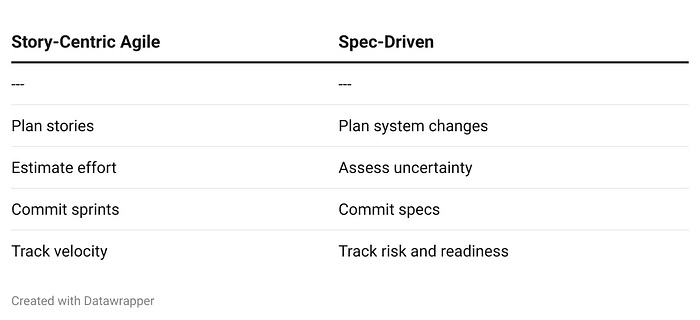
What changes from Agile planning
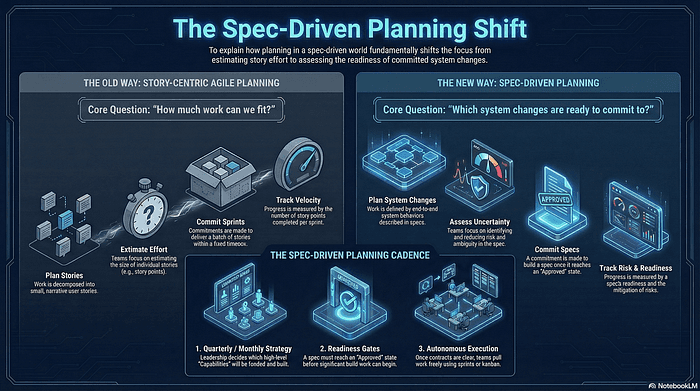
How planning works
Quarterly / monthly: decide which capabilities will be funded and built
Readiness gates: specs must reach Approved before serious build begins
Execution: teams pull work freely once contracts are clear
Teams may still run sprints or kanban flow, but commitments are expressed in terms of spec states — for example, “these capabilities will reach Approved this quarter.”
Planning shifts from:
“How much work can we fit?” → “Which system changes are ready to commit to?”
5. The Artifact Hierarchy
Traditional Agile hierarchy:
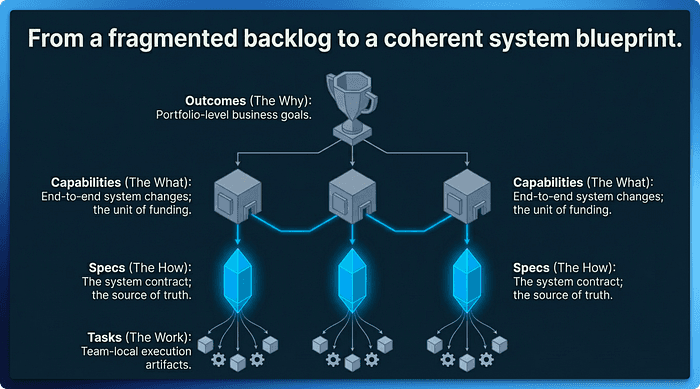
Spec-driven hierarchy:
Key shifts:
Features, epics, and stories collapse into Capabilities + Specs
Tasks remain, but are team-local execution artifacts
Specs replace backlogs as the definition of intent
6. Outcomes and Capabilities
Outcomes (Why)
Portfolio-level goals
Business or customer impact
Example: Reduce manual contract abstraction cost by 60%
Capabilities (What)
End-to-end system changes
Primary unit of funding and tracking
Example: Automated Financial Term Extraction
7. What Makes Up a Spec
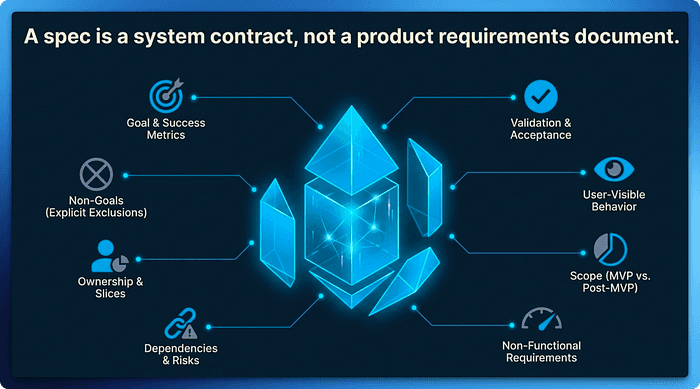
👁️ A spec is not a PRD. It is a system contract.
Unlike PRDs, which often mix market context, feature lists, and UX detail, specs here stay narrowly focused on testable system behavior, constraints, and contracts.
Core sections of a spec
Goal and success metrics
Non-goals (explicit exclusions)
Core invariants
User-visible behavior
Edge cases
Scope definition (MVP vs post-MVP)
Non-functional requirements
Ownership and execution slices
Dependencies and risks
Validation and acceptance
Rollout and migration
MVP vs post-MVP example
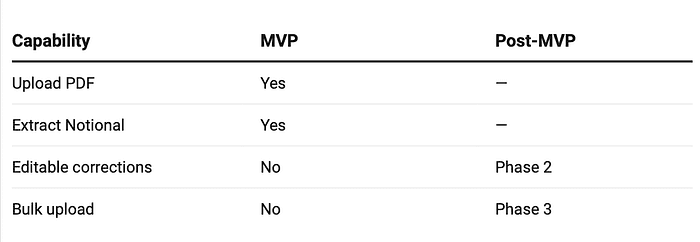
MVP vs Post-MVP Example
The spec remains structurally complete. The MVP activates only a subset of behaviors, constraints, and guarantees.
8. Who Contributes to Specs
👁️ Specs are joint artifacts built in collaboration across Product, Engineering and TPMs.
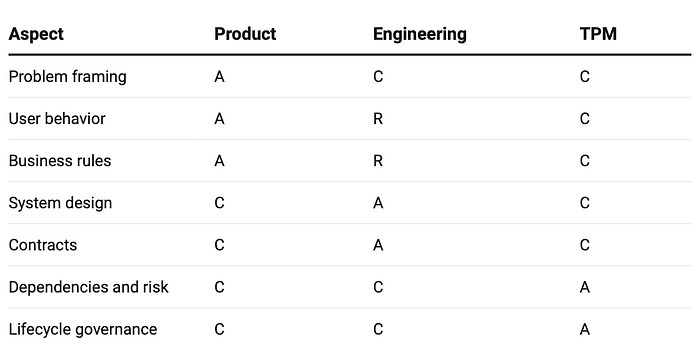
(A = Accountable, R = Responsible, C = Consulted)
9. Change, Zones, and Spec Status
👁️ Specs are designed to change — but not everything equally.
Three zones inside a spec
Stable Zone — Invariants, data models, contracts, security. Changes require explicit re-approval.
Flexible Zone — UX details, thresholds, heuristics. Changes allowed during build.
Exploratory Zone — Open questions and experiments. Must be resolved or explicitly deferred.
Reviews should explicitly call out which edits touch the Stable Zone versus the Flexible or Exploratory zones so stakeholders understand when re-approval is required.
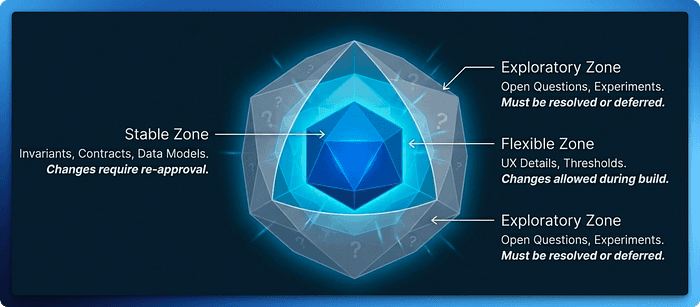
Spec lifecycle
👁️ “Approved” means stable zones are locked, not that learning stops.
10. Versions and MVP
v0.x — shaping and exploration
v1.0 — MVP behavior agreed and shipped
v1.x — refinements within agreed scope
v2.0 — breaking change or new capability slice
Versioning preserves learning without erasing decisions.
11. Preventing “Waterfall Strikes Back”
Spec-driven development fails when specs become heavy, static documents.
What prevents that:
Thin, focused specs
Explicit exploratory zones
MVP slicing
Continuous delivery unchanged
Versioned change instead of rewrite
👁️ As a rule of thumb, most specs should move from Draft to Approved in days or a couple of weeks; multi-month spec cycles are a smell.
Specs define guardrails — not detailed task plans.
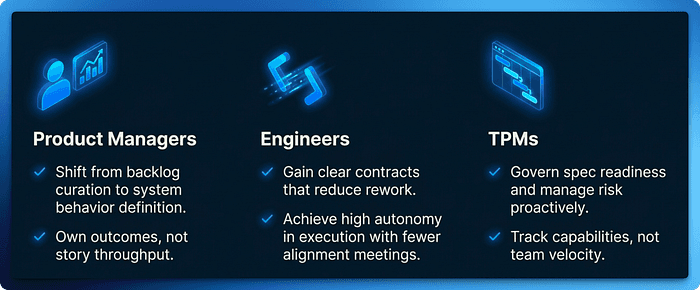
12. What This Means for Each Role
🔮 Product Managers
Shift from backlog curation to system behavior definition
Make tradeoffs and non-goals explicit
Own outcomes, not story throughput
👩🔬 Engineers
Clear contracts reduce rework
Fewer coordination meetings
High autonomy in execution
🚚 TPMs
Govern spec readiness and risk
Track capabilities, not velocity
Freeze contracts early to enable parallelism
Backlog grooming is replaced or supplemented by spec readiness reviews and capability reviews.
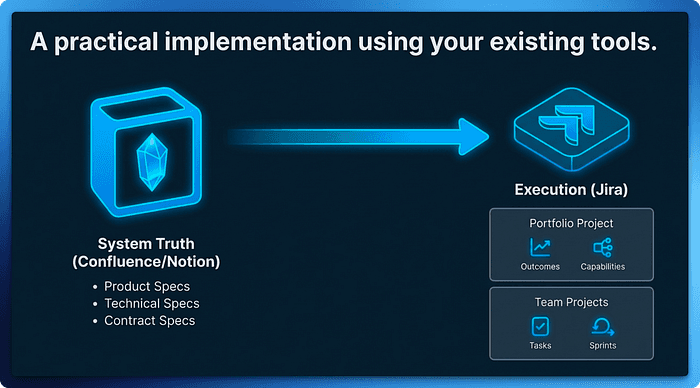
13. Implementing with Jira and Confluence
Jira (execution and coordination)
Outcomes / Bets (optional)
Capabilities (mandatory)
Tasks (team-local)
Confluence or Notion (system truth)
Product specs
Technical specs
Contract specs
Rollout specs
Ownership and MVP definitions
Potential setup
One Portfolio Jira Project for outcomes and capabilities
Separate Team Jira Projects for tasks and sprints
Example: the Capability “Automated Financial Term Extraction” (Jira) links directly to its Product, Technical, Contract, and Rollout specs in Confluence.
Design choice (intentional):
Tasks link to Capabilities.
Capabilities are planned and tracked independently of task roll-ups.
14. Why This Works
💪 Fewer artifacts, more signal
💪 Explicit system truth
💪 Controlled change
💪 Team autonomy
💪 Higher delivery confidence
👁️ This is not anti-Agile. Most teams will continue to use Agile or flow-based execution. It is post–story-centric Agile.
Final Mental Model
👁️ Outcomes fund Capabilities. Capabilities are defined by Specs. Specsallocate ownership. Teams execute locally.
Everything else is implementation detail.